The concept of doughnut economy, developed by Kate Raworth, is an effective approach to identifying the state of sustainable development in countries or regions. It combines planetary constraints with societal indicators to provide a holistic assessment of economic and social progress, taking into account environmental constraints.

The concept of Doughnut Economy

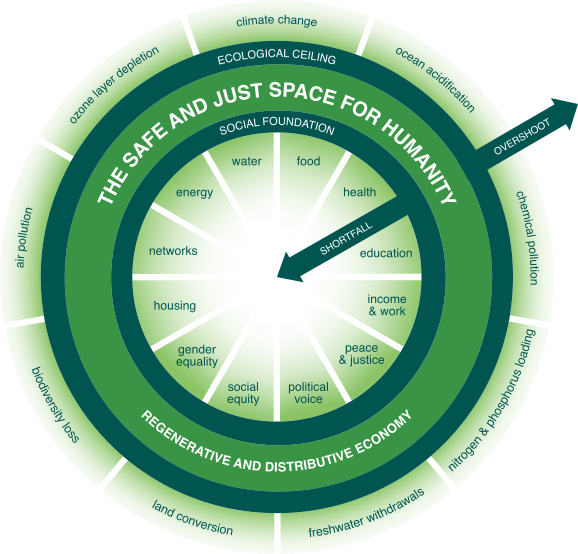
The Oxford-based Doughnut Economics Action Lab (DEAL) addresses social and ecological challenges using the ring doughnut model developed by Kate Raworth. This concept, which combines planetary constraints and sustainability indicators, was first introduced in 2012 in an Oxfam report. Raworth took the idea further in her book “Doughnut Economics” (2017), which became an international bestseller. Composed of a social foundation and an ecological ceiling, the doughnut ring acts as a compass for human well-being as it seeks to meet the needs of all people within the capacity of the planet, creating an ecologically safe and socially just space for human development.
The ring doughnut model.
The goal of the 21st century is to meet the needs of all people within the limits of our living planet – which means entering the “ring doughnut”. This cannot be achieved with the economic approach of the last century. The economics of the ring doughnut brings a new way of thinking adapted to the challenges of today. It is not just about specific policies or institutions, but a mindset that promotes the sustainable and equitable solutions needed to respond successfully to the challenges of our time.

Drawing on insights from different schools of economics – including ecological, feminist, institutional, behavioural and complexity economics – the economics of the ring doughnut offers seven key approaches to guide the thinking of contemporary economists in the 21st century. These approaches are transforming economies at all levels, from the local to the global.
The economics of the ring doughnut shifts the focus from endless GDP growth to achieving sustainable success within safe frameworks. It emphasises that the economy is closely linked to society and the natural environment, and that we need to look at these three areas holistically. This approach recognises that human behaviour can foster cooperation and caring as well as competition and individualism. It also emphasises that economies, societies and the natural world are complex and interconnected systems that need to be understood using systems thinking. The economics of the ring doughnut calls for the transformation of today’s destructive economies into regenerative ones and for a transition towards more just and inclusive systems. It recognises that growth may be a natural part of development, but nothing grows forever – true success comes when we reach maturity and can move forward without the need for further growth.

Empirical research based on the ring doughnut concept

Fanning and co-authors find that increased resource consumption reduces the performance of social action on indicators such as life satisfaction, life expectancy, CO₂ emissions, energy consumption and ecological footprint. The models examine the impact of achieving the SDGs on planetary constraints and the socio-economic impacts associated with reducing CO₂ emissions and energy requirements to meet basic needs. However, they point out that many studies often do not disaggregate data at the national level or include multiple planetary constraints and social indicators. Only one study provides a global analysis of the level of resource consumption to meet minimum societal thresholds, but it is limited to one year.
A two-pronged approach is needed to reach social thresholds without exceeding biophysical limits:
  • limiting excessive wealth and consumption by the rich and
  • preventing extreme scarcity among the least well-off.

A better understanding of countries’ trajectories on the ring doughnut can provide insights into the necessary actions to transform unsustainable systems. Empirical research combining social and biophysical indicators within the ring doughnut framework is advancing, and this framework is already being used to assess the performance of cities, regions, countries and the world.
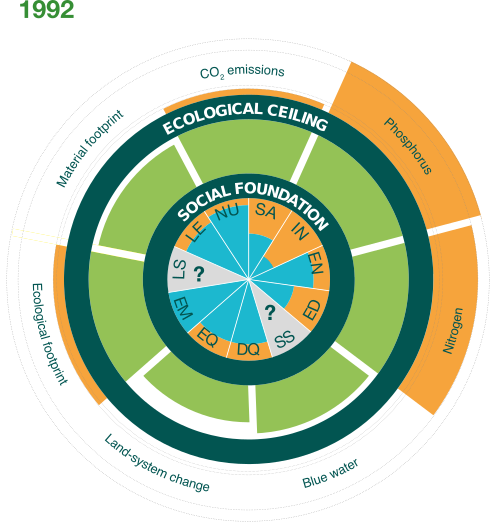
Global success represented with the ring doughnut model for the year 1992.
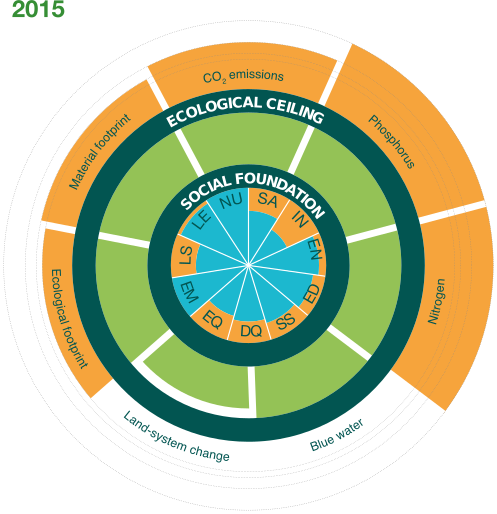
Global success represented with the ring doughnut model for the year 2015.

Legend

*Blue water is water found in rivers, lakes and groundwater and used for drinking, irrigation and industrial purposes.

Historical dynamics of 11 social and 6 biophysical indicators in more than 140 countries were analysed over the period 1992-2015. Three planetary constraints (climate change, biogeochemical fluxes and land use) were compared with the environmental footprint of countries, using ecological and material footprints. Social performance was assessed on 11 indicators such as life satisfaction, life expectancy, access to food, sanitation, energy, education, social support, quality of democracy, equality and employment, and compared to minimum values.
The findings show that countries that meet social targets often use resources unsustainably, while countries that use resources sustainably fall short of social standards. Globally, billions of people live in countries that fall below most social thresholds, while humanity as a whole exceeds six of the seven global biophysical limits. Despite some progress since the 1990s, significant deficits remain and global resource use has increased significantly, particularly in material footprint and CO₂ emissions.
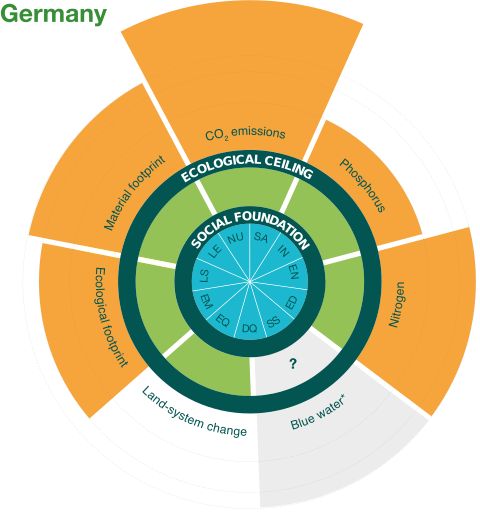
The success of Germany represented with the ring doughnut model.
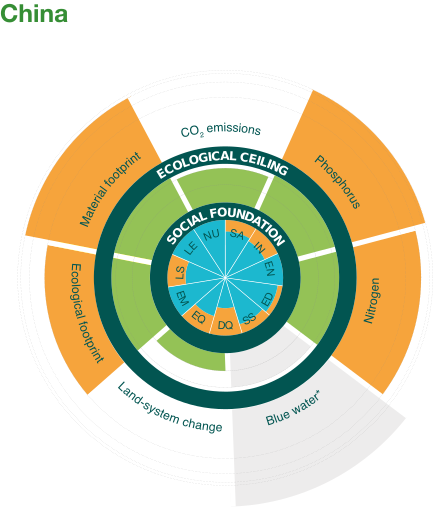
The success of China represented with the ring doughnut model.
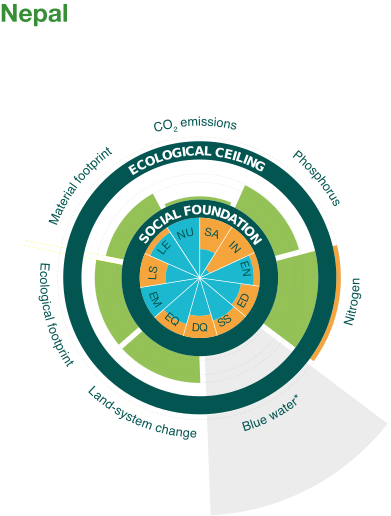
The success of Nepal represented with the ring doughnut model.

Legend

*Blue water is water found in rivers, lakes and groundwater and used for drinking, irrigation and industrial purposes.

The analysis shows that countries are moving beyond biophysical limits faster than they are reaching social limits. The number of countries exceeding the biophysical limits increased by 32-55%, depending on the indicator, while social performance improved in only five indicators, worsened in two and remained almost unchanged in the rest. The data from this study are available on the DEAL (Doughnut Economics Action Lab) website.

High-performing regions often use resources in an unsustainable way, while low-performing regions do not achieve a sufficient social base. Globally, billions of people live in countries that fall below most social thresholds, while humanity exceeds six of the seven global biophysical limits.
Projections to 2050 show that current trends are exacerbating the ecological crisis and failing to address societal deficits. The number of countries exceeding CO₂ limits is likely to more than double. High-income countries such as Germany need to reduce resource use, while middle-income countries such as China face the challenge of improving social performance while reducing resource use. Low-income countries such as Nepal can increase resource use, but need to accelerate improvements in social indicators to avoid scarcity.

Doughnut Economy: New economic paradigm

The doughnut economy represents a new vision for the economy and sustainable development. The visual framework in the form of a ring doughnut combines the concept of planetary constraints with societal needs. The aim is to shift economic priorities from simply increasing GDP to creating a society that provides sufficient goods and services for all, while managing resources sustainably. The advantage of this framework is that it allows an assessment of whether current economic and energy models are working within ecological constraints. Ideally, different aspects of the economy should operate within regenerative and equitable frameworks for both the environment and society.
Kate Raworth has expanded on the concept of doughnut economics in her book ‘The Economics of the Ring Doughnut: Seven Ways to Think Like a 21st Century Economist’. In the book, she describes the frustrations of economics students who cannot find answers in traditional textbooks, and shares her experiences in Zambia and working on human development reports for the UN. The author suggests that economics should be seen through the prism of goals, not just mechanisms, and presents the transition from old to new ways of thinking using a series of diagrams that offer a new, broader perspective for 21st century economists.

Seven ways to think like a 21st century economist

Seven Ways to Think

From 20th-Century Economics

To 21st-Century Economics

1.
Change the goal

From 20th-Century Economics

GDP

To 21st-Century Economics

the Doughnut

2.
See the Big Picture

From 20th-Century Economics

Self-contained market

To 21st-Century Economics

Embedded economy

3.
Nurture Human Nature

From 20th-Century Economics

Rational economic mac

To 21st-Century Economics

Social adaptable humans

4.
Get Savvy with Systems

From 20th-Century Economics

Mechanical equilibrium

To 21st-Century Economics

Dynamic complexity

5.
Design to Distribute

From 20th-Century Economics

Growth will even it up again

To 21st-Century Economics

Distributive by design

6.
Create to Regenerate

From 20th-Century Economics

Growth will even it up again

To 21st-Century Economics

Regenerative by design

7.
Be Agnostic about Growth*

From 20th-Century Economics

Growth addicted

To 21st-Century Economics

Agnostic Growth

* “Agnostic about growth” means that we do not advocate a blind obsession with continuous economic growth. Instead, we are open to the possibility that growth is not always necessary or desirable, focusing instead on other aspects such as quality of life, environmental sustainability, and social justice.

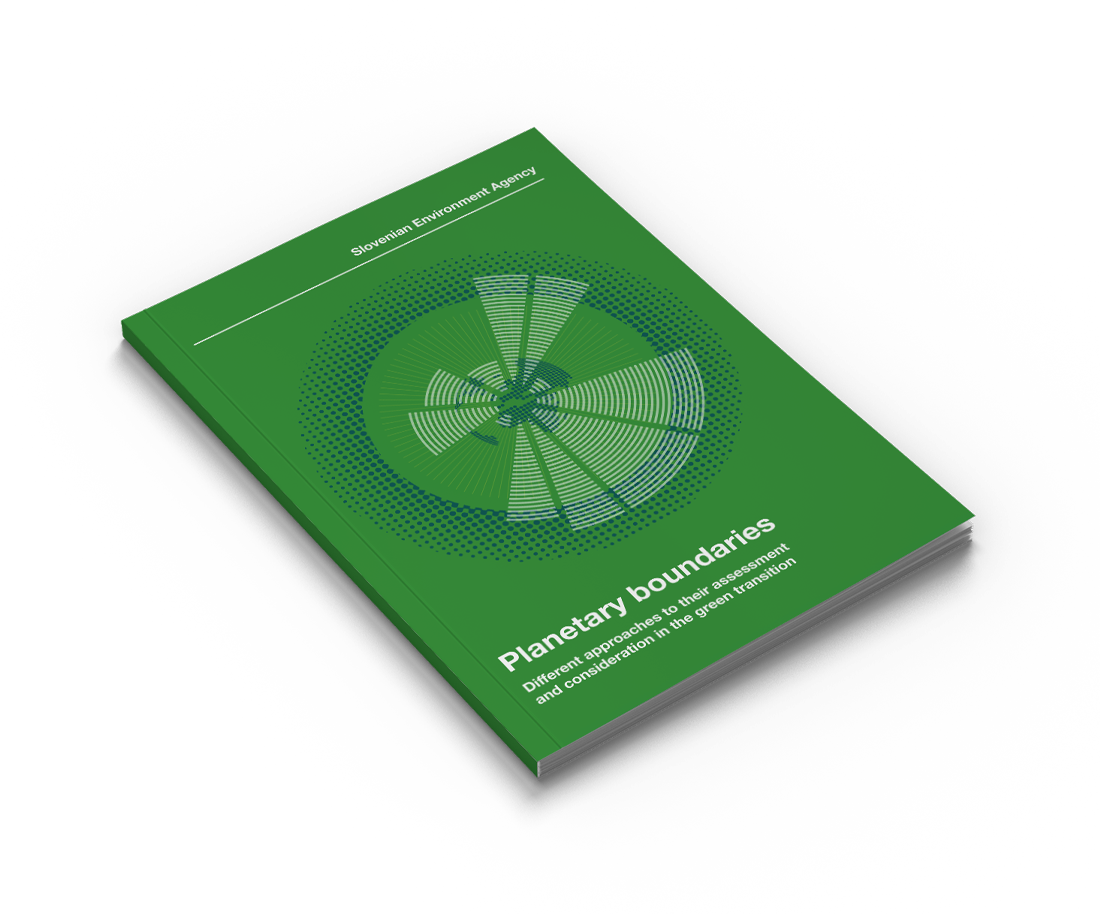
Planetary boundaries

Discover various approaches to evaluating planetary boundaries and their consideration in the green transition.

The informational material includes detailed explanations of research approaches, analyses, and graphical representations.
The cover of the Planetary boundaries brochure.