Ecological footprint as an indicator of biological regenerative capacity, consumption, and well-being in relation to selected planetary boundaries

Ecological footprint is an important indicator that measures human impact on ecosystems. It is a tool to monitor the balance between human needs and the regenerative capacity of the planet. The links between ecological footprint and planetary constraints can help improve sustainable policies.
Ecological footprint as a measure of regenerative growth
If regenerative growth is understood as economic development where human needs do not exceed the regenerative capacity of the planet, it is important to monitor this balance. The ecological footprint is a sustainability indicator that measures human pressure on ecosystems. It is calculated by the Global Footprint Network for around 200 countries, including Slovenia. It measures the sum of all human demands on biologically productive land and compares them to biocapacity. The ecological footprint is expressed in the unit “global hectare” (gha). It includes the footprints of arable land, grazing land, forests, fishing grounds, built-up areas and carbon footprint.
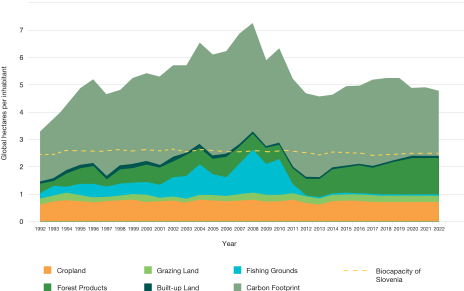
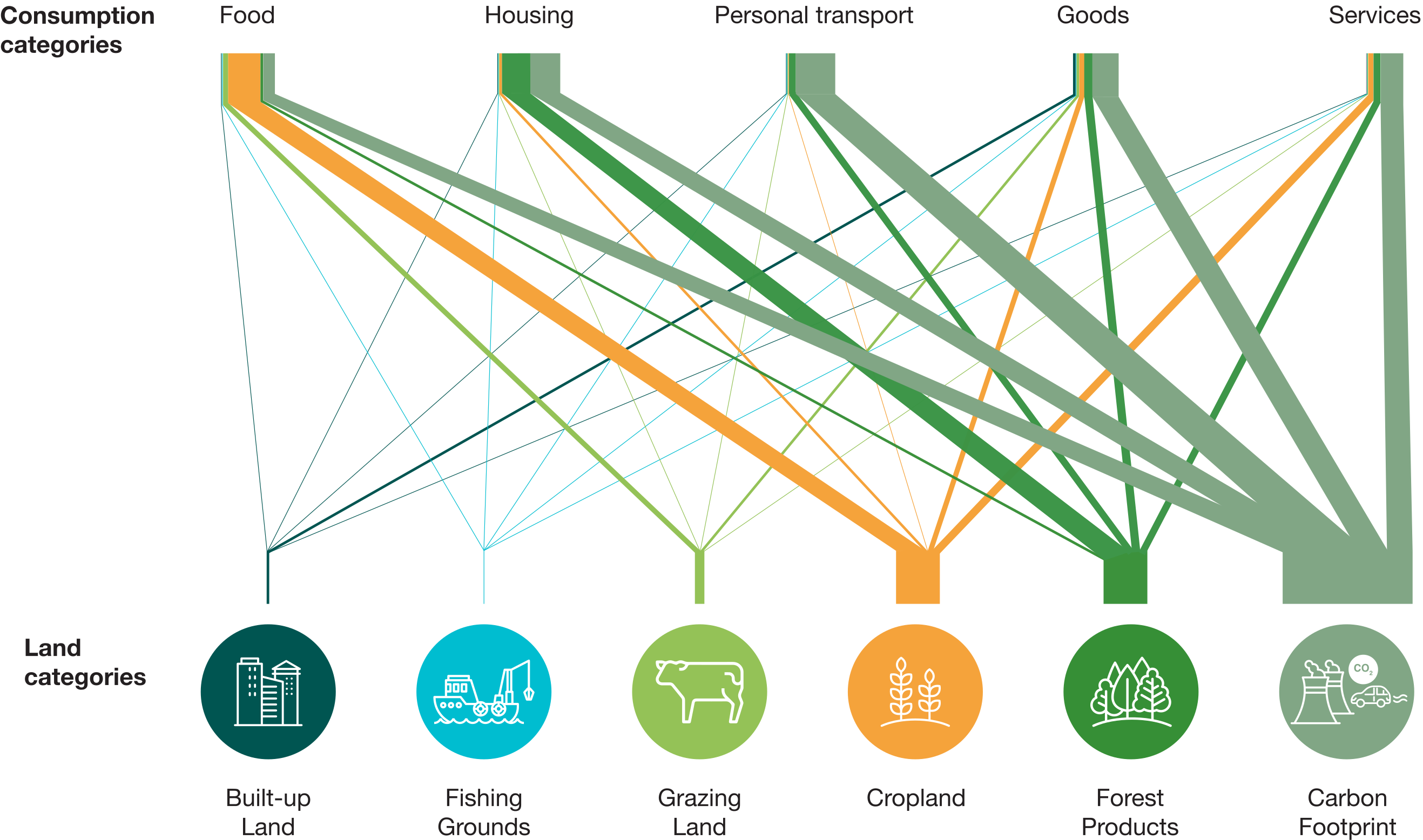
The ecological footprint time series shows important changes, such as the decrease in the carbon footprint after 2008 and the increase in the footprint of forest products due to climate change. If Slovenia achieves a zero carbon footprint, the ecological footprint will be reduced to the biocapacity level. This will depend on domestic measures to phase out fossil fuels and on carbon footprint reductions in importing countries. The ecological footprint is a strategic indicator in the Slovenian Development Strategy 2030 and the National Programme for Environmental Protection, with a target of a 20% reduction by 2030. It is also used in regional development programmes and in Slovenia’s annual development reports.

Using footprints to assess planetary constraints
Despite the adoption of the Sustainable Development Goals, the measurement of the Ecological Footprint (EF) and the Human Development Index (HDI) shows that few countries are moving towards sustainable development. Higher levels of development are accompanied by a higher ecological footprint, indicating that development is taking place without taking environmental performance into account. Developing countries are following developed countries in putting pressure on the environment, and all countries need to move decisively towards sustainable development.
The ecological footprint is a tool for evaluating the impact of human activity on planetary constraints, based on the logic that exceeding the regenerative capacity of the Earth leads to the degradation of natural capital. It measures human demand for biologically productive land and natural resources and compares it with the planet’s regenerative capacity. This indicator provides a clear indication of when countries or regions are exceeding planetary limits, such as carbon absorption capacity, biodiversity and natural resource consumption.
The ecological footprint is a tool for evaluating the impact of human activity on planetary constraints, based on the logic that exceeding the regenerative capacity of the Earth leads to the degradation of natural capital. It measures human demand for biologically productive land and natural resources and compares it with the planet’s regenerative capacity. This indicator provides a clear indication of when countries or regions are exceeding planetary limits, such as carbon absorption capacity, biodiversity and natural resource consumption.
The burning of fossil fuels is the biggest contributor to the ecological footprint of developed countries, contributing to climate change and biodiversity loss.
The Ecological Footprint (EF) is a strategic indicator in the Slovenian Development Strategy 2030 and the National Programme for Environmental Protection. Its analysis helps understand how human resource use affects planetary boundaries, allowing policies to be adapted at the regional and national level. In this way, the ecological footprint becomes a key tool for identifying current and future challenges related to the limits of the Earth’s natural resources and guiding actions towards a sustainable future.
The Ecological Footprint (EF) is a strategic indicator in the Slovenian Development Strategy 2030 and the National Programme for Environmental Protection. Its analysis helps understand how human resource use affects planetary boundaries, allowing policies to be adapted at the regional and national level. In this way, the ecological footprint becomes a key tool for identifying current and future challenges related to the limits of the Earth’s natural resources and guiding actions towards a sustainable future.
How to keep track of planetary constraints and a green, prosperity-oriented economy at the same time?
Kate Raworth’s ring doughnut concept is a way to simultaneously monitor planetary constraints and the development of a green, prosperity-oriented economy. The DEAL (Doughnut Economics Action Lab) methodology combines environmental limits with social and sustainability indicators to offer a holistic approach that allows a balanced monitoring of economic progress without exceeding the ecological capacity of the planet.
In this context, the research addresses three key planetary boundaries – climate change, biogeochemical fluxes and terrestrial system change – and includes indicators such as CO₂ emissions, human appropriation of net primary production, and nitrogen and phosphorus levels. These indicators can be used to measure how countries are progressing in the transition towards a green economy that supports prosperity without exceeding natural resource constraints. Data on ecological and material footprints are also included to complement this analysis.
The study is based on an examination of historical data (1992-2015) and projections to 2050, with a particular focus on the applicability and feasibility of the approach for Slovenia. Relevant data and country-specific graphical displays provide insights into how Slovenia is reconciling sustainable resource use with its green economy objectives. The methodology is based on the principle of equity and examines whether countries are meeting the basic needs of their populations in a sustainable manner, taking into account the limits of the planet’s regenerative capacity.
In this context, the research addresses three key planetary boundaries – climate change, biogeochemical fluxes and terrestrial system change – and includes indicators such as CO₂ emissions, human appropriation of net primary production, and nitrogen and phosphorus levels. These indicators can be used to measure how countries are progressing in the transition towards a green economy that supports prosperity without exceeding natural resource constraints. Data on ecological and material footprints are also included to complement this analysis.
The study is based on an examination of historical data (1992-2015) and projections to 2050, with a particular focus on the applicability and feasibility of the approach for Slovenia. Relevant data and country-specific graphical displays provide insights into how Slovenia is reconciling sustainable resource use with its green economy objectives. The methodology is based on the principle of equity and examines whether countries are meeting the basic needs of their populations in a sustainable manner, taking into account the limits of the planet’s regenerative capacity.
Keeping track of “progress” through time, 1992–2015
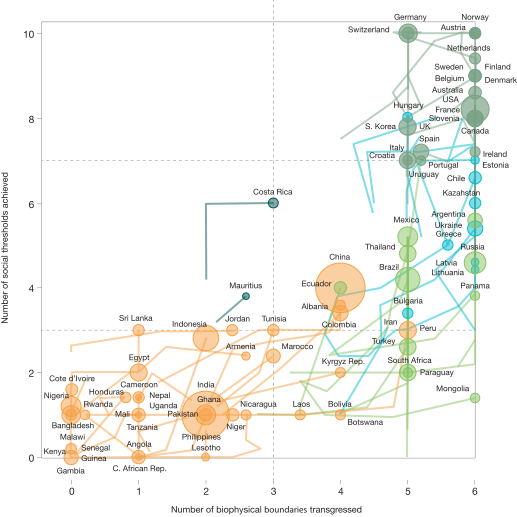
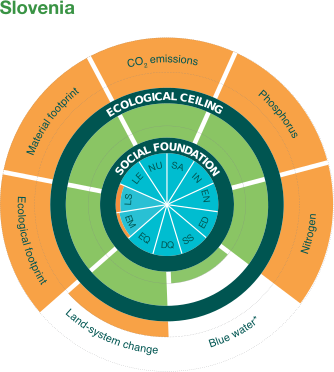
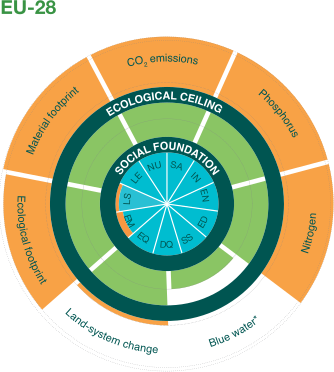
- ecological ceiling and social foundation comprising a doughnut of social and planetary boundaries
- overall consumption of resources with regard to each of the global biophysical boundaries, beginning at the outer edge of social foundations
- average social performance with regard to each of the social foundations, weighted by population number
- shortfall below the social foundation of transgressing the biophysical barriers
- indicator with incomplete data
The study does not include time series, as most of the indicators refer to 2011. These indicators provide a more detailed picture of developments in Slovenia, especially in comparison with other EU countries, which may indicate policy gaps or specific geographical characteristics of Slovenia. For example, despite exceeding the thresholds for nitrogen and phosphorus, Slovenia has a less intensive agriculture compared to the EU average due to its terrain, which favours livestock farming over arable farming.
Another important question is how the limit values were set. Some thresholds are based on clear logic (e.g. comparing ecological footprint with biocapacity) or are well researched (e.g. climate neutrality). However, other thresholds are more difficult to identify and explain, as their values are also influenced by local or regional geographical characteristics (e.g. the impact of nitrogen and phosphorus on particular catchments).
Using footprints to evaluate planetary boundaries
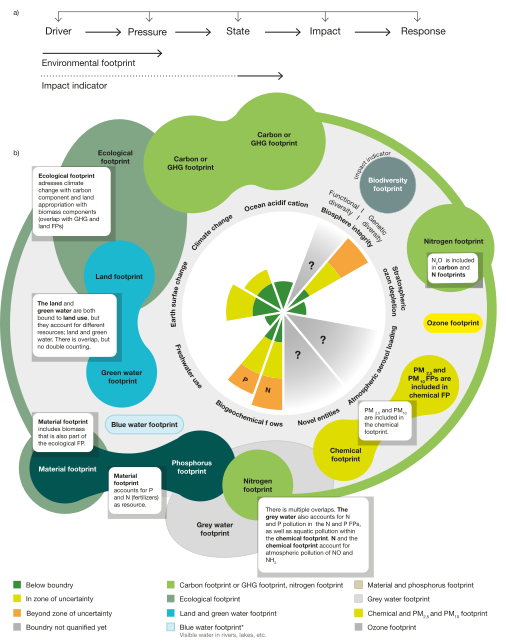
Experts report that since 1996, when Wackernagel and Rees introduced the first measurement of the ecological footprint, many other footprints have emerged. Most articles focus on the carbon, water, and ecological footprints, while others include footprints related to soil, nitrogen, phosphorus, material footprint, as well as footprints for biodiversity, chemicals, PM2.5 particles, PM10, ozone, and energy. This terminology is also used in the environmental footprint of products and organizations based on the life cycle assessment (LCA) of the European Commission.
The JRC Consumption Footprint Platform for the EU-27 reports on the environmental impact of consumption at the European level for the period 2010–2021. The assessment includes detailed analyses of the environmental footprint at the product level, allowing for more precise monitoring of consumption’s impact on the environment. A comparison of weighted results—impact per capita—shows that Slovenia’s overall consumption footprint is lower than the EU-27 average (0.81 for Slovenia and 0.95 for the EU-27).
This analysis is significant as it highlights how different products and services affect the environment, enabling more informed policymaking for sustainability and strategies to reduce the environmental footprint at both the national and European levels. Although the JRC platform provides an extensive overview of consumption impacts, even more in-depth and detailed data can be obtained using REX3.
REX3 (Resolved EXIOBASE3 version 3) contains a comprehensive set of environmental indicators related to climate impacts, health impacts from particulate emissions, water stress, as well as biodiversity loss due to land use change and freshwater eutrophication. The assessment of climate impacts in the REX3 system includes not only greenhouse gas emissions related to combustion and biogenic greenhouse gas emissions but also emissions resulting from land use changes. To evaluate the impact on biodiversity, spatially disaggregated data, offering insights into global land occupation and land use changes for the period 1995–2022, were combined with global species loss factors for individual ecoregions.
This approach enables a detailed assessment of biodiversity loss due to changes in natural habitats and the benefits of restoration measures in high spatial resolution, including recent temporal trends. In addition to environmental impact assessments, REX3 also includes the socio-economic indicators “labor force” and “value added.”
This analysis is significant as it highlights how different products and services affect the environment, enabling more informed policymaking for sustainability and strategies to reduce the environmental footprint at both the national and European levels. Although the JRC platform provides an extensive overview of consumption impacts, even more in-depth and detailed data can be obtained using REX3.
REX3 (Resolved EXIOBASE3 version 3) contains a comprehensive set of environmental indicators related to climate impacts, health impacts from particulate emissions, water stress, as well as biodiversity loss due to land use change and freshwater eutrophication. The assessment of climate impacts in the REX3 system includes not only greenhouse gas emissions related to combustion and biogenic greenhouse gas emissions but also emissions resulting from land use changes. To evaluate the impact on biodiversity, spatially disaggregated data, offering insights into global land occupation and land use changes for the period 1995–2022, were combined with global species loss factors for individual ecoregions.
This approach enables a detailed assessment of biodiversity loss due to changes in natural habitats and the benefits of restoration measures in high spatial resolution, including recent temporal trends. In addition to environmental impact assessments, REX3 also includes the socio-economic indicators “labor force” and “value added.”
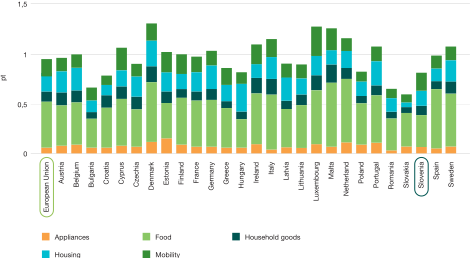
Prispevek posameznih področij potrošnje k skupnemu odtisu potrošnje, enotno tehtani rezultati – vpliv na prebivalca, EU-27, leto 2021.
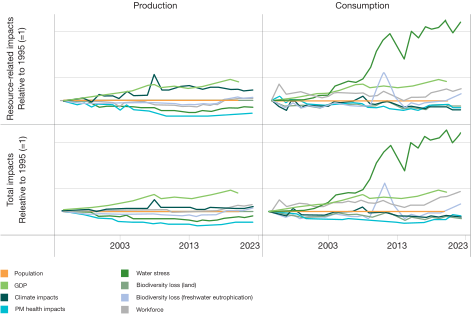
Podatki za Slovenijo, izračunani z REX3, za tri planetarne omejitve in socialno-ekonomske kazalnike (pridobljeni iz vizualizatorja podatkov iz REX3).
The REX3 database offers significant opportunities for linking planetary boundaries and green growth, connecting both climate actions with biodiversity and natural environment goals. The results for Slovenia highlight the need to address water stress in the context of consumption and trade.
Planetary boundaries
Discover various approaches to evaluating planetary boundaries and their consideration in the green transition.
The informational material includes detailed explanations of research approaches, analyses, and graphical representations.
The informational material includes detailed explanations of research approaches, analyses, and graphical representations.