The well-being economy is a new paradigm of economic development that goes beyond traditional indicators such as GDP. Its goal is to create an economic system that enables sustainable growth and well-being for all, while taking environmental limitations into account. The path to this goal can be found through the use of various concepts and approaches.

The well-being economy in the Earth4All initiative

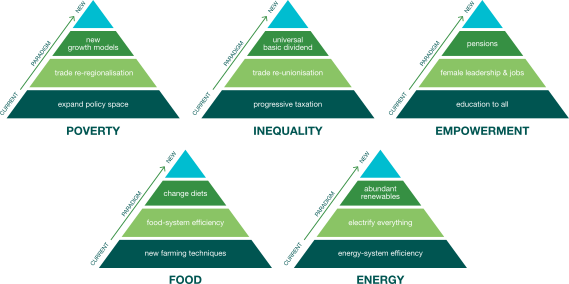
The authors of the Earth4All report identify the three most powerful socio-economic levers for each transformation. At the base of the pyramid, in their view, are fundamental policy changes within the current economic paradigm. From there, they move upwards to more ambitious policies that actually define a new economic paradigm suitable for the Anthropocene. At the top of the pyramid are the levers that truly ensure the transformation into a new economic paradigm, which some refer to as the “well-being economy.”
The Earth for All program presents a few key ideas: only through the early and decisive activation of bold levers can the Earth4All model achieve an accelerated transformation towards a fairer, more equitable, and safer world by the middle of this century. Returning humanity to a safe operating space within this century may be challenging and complex, but, as with many other complex projects, this process can be triggered by a handful of well-chosen levers executed by dedicated groups of people.

The paradigm shift of Earth4All is illustrated with five triangles.

Pyramids that show the transition from the current state to a new state for poverty, inequality, empowerment, food and energy.
Experts emphasize that these levers are clearly identifiable and ready for use. All of them stem from one key area – the economy.

The key ones among them are:
The establishment of citizens’ funds to fairly distribute the wealth of global commons among all citizens.
Government intervention (subsidies, incentives, and regulations) to accelerate transformations.
Transformation of the international financial system to enable the rapid reduction of poverty in much of the world.
Reduction of investment risks in low-income countries and debt cancellation.
Investments in efficient, regenerative food systems and renewable energy systems.

The well-being economy of Mark Anielski: the concept and its implementation in Slovenia

The concept of the well-being economy by Mark Anielski

Mark Anielski, in his books “The Economics of Happiness” (2007) and “The Economics of Well-Being” (2018), presented a blueprint for creating new well-being economies using an accounting system to measure the conditions of well-being in communities, based on values and virtues. He has advised numerous regional and governmental institutions.
The Genuine Wealth Model:
  • Designed to support the well-being economy.
  • Measures and manages well-being based on values, tracking progress and performance according to the values of the community or organization.
  • Uses a conventional financial accounting structure to assess the return on investment in five key assets/commons of the community or business.
  • Offers a practical tool to guide decision-making on economic development, policies, and budgeting.
  • Assists in making economic, social, and environmental decisions.
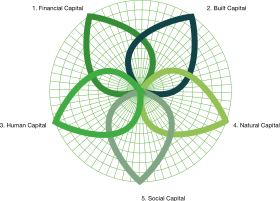
The model of the five types of capital.
Genuine Wealth: The Five Capitals Model. Source: Anielski, 2023.
The Five Types of Capital in Genuine Wealth:
1. Human capital: The mental, physical, emotional, and spiritual well-being of people, their skills, abilities, and dreams.
2. Social and Cultural Capital: A sense of belonging, community, and trust, as well as the cultural assets of the community or organization.
3. Natural Capital: The abundance and resilience of the natural environment, including water, air, soil, and natural resources.
4. Built Capital: The integrity and value of infrastructure, homes, buildings, equipment, ideas, patents, and innovations.
5. Financial Capital: The financial resources of individuals, businesses, and communities.

The model combines an authentic way of living, aligned with values, and the conditions for well-being, leading to the creation of resilient and flourishing communities.

Genuine Indicators of Progress in the Example of Well-Being for Alberta, Canada

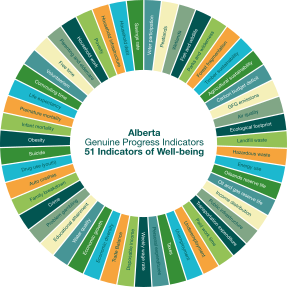
Over the last 25 years, alternative progress indicators have been developed due to criticisms of GDP as a measure of well-being. One of the most significant is the Genuine Progress Indicator (GPI), introduced in 1995 in the USA. GPI incorporates environmental and social costs, such as pollution, crime, inequality, and chronic diseases. The Alberta GPI project, led by Mark Anielski, developed a more comprehensive balance sheet for the province of Alberta, Canada, taking into account 51 key indicators of well-being—human, social, environmental/natural, built infrastructure, and financial.
These 51 well-being indicators were tracked over the period from 1961 to 2001, showing results similar to the U.S. GPI index. While Alberta’s GDP increased, the overall state of well-being has declined and stagnated since the 1960s. The work on the GPI index involved converting raw data into a scale from 1 to 100, where 100 represents an optimal state of well-being. The system allows for the examination of connections between GDP growth and other indicators such as life expectancy, chronic diseases, air quality, and ecological footprint.

Genuine Progress Indicators in the Case of Alberta, Canada.

51 indicators of well-being for Alberta, Canada.

Creating a Well-Being Economy for Slovenia

Anielski (2023) states that Slovenia is ideally positioned to become a model well-being economy. Opportunities for adopting a well-being economy management approach include:

  1. Utilizing an integrated accounting and decision-making system for genuine wealth (five capitals: human, socio-cultural, natural, built, and financial).
  2. Incorporating the UN Sustainable Development Goals into Slovenia’s economic-ecological-well-being framework.
  3. Offering comparative advantages in quality of life among EU countries.
  4. Highlighting the need for improvements in certain areas, reflected in ongoing efforts to align with the principles of sustainable development and well-being as outlined in the Slovenia Development Strategy 2030.

Slovenia's Development Strategy 2030 - Key Aspects and Efforts for Achieving Sustainable Well-Being:

It includes 12 goals, strategies, and 6 key ‘quality of life’ indicators, aligned with the well-being economy model.
A commitment to measuring and reporting on genuine progress in achieving goals (life expectancy, healthy lifestyle, low inequality, vibrant culture, sustainable resource management, high employment, trust, security, low-carbon circular economy, and efficient high-quality public services and governance).

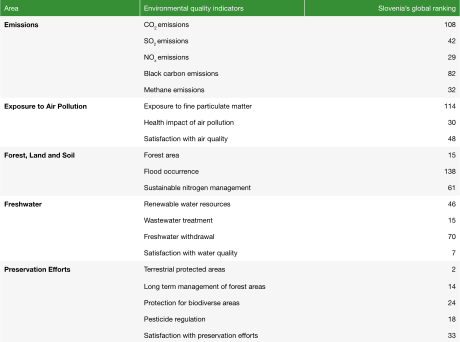
Environmental quality indicators for Slovenia by area and global ranking

A table containing environmental quality indicators for Slovenia by area and global ranking.
Data from the table shows that Slovenia achieves solid results in nature conservation, particularly in protected areas (2nd place) and forest management (14th place). This reflects efforts to safeguard natural resources, which are crucial for long-term sustainable economic growth within the framework of the well-being economy as outlined by Anielski.

However, Slovenia faces challenges in CO₂ emissions (108th place) and air pollution (e.g., health impacts from pollution, 30th place). Despite progress in conserving nature and water resources, environmental pressures from emissions and pollution remain problematic. This indicates the need for continued efforts to reduce the ecological footprint and improve air quality.

In the context of the well-being economy, it is essential for Slovenia not only to conserve natural resources but also to reduce environmental pressures, particularly in emissions, to achieve more sustainable and equitable economic growth.

Anielski believes that Slovenia is well on its way to becoming a model of a well-being economy in Europe. It has a population with a long life expectancy, resilient forests, low income inequality, a highly educated population, high social capital, good employment conditions, and high life satisfaction.

Slovenia faces challenges in social and natural capital, as well as aligning its ecological footprint with its biocapacity. Anielski recommends measuring subjective well-being, surveying the population, and adopting budgetary and political approaches based on well-being, similar to those in New Zealand, Iceland, Finland, and Scotland.

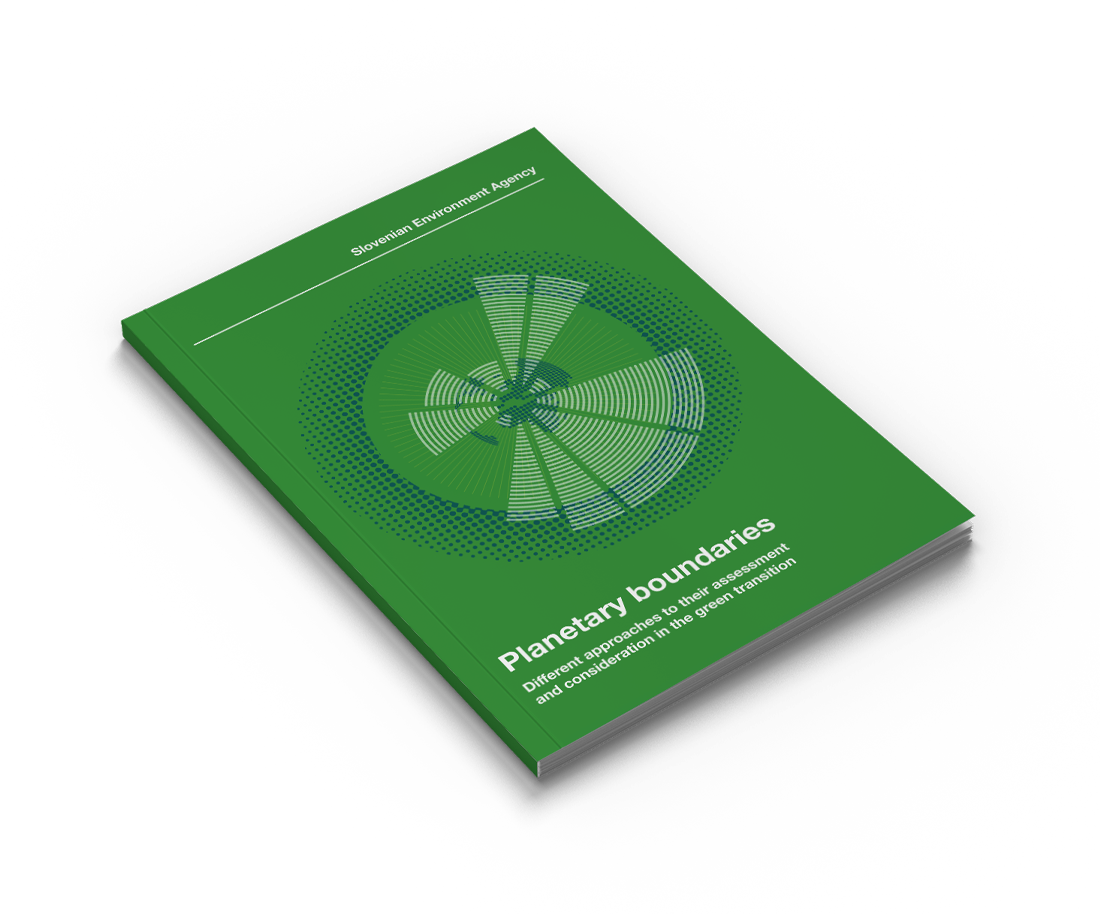
Planetary boundaries

Discover various approaches to evaluating planetary boundaries and their consideration in the green transition.

The informational material includes detailed explanations of research approaches, analyses, and graphical representations.
The cover of the Planetary boundaries brochure.