The impact of humanity on Earth’s natural systems, including the climate, has been so significant since the mid-20th century that scientists speak of the Anthropocene, a new geological epoch in which humans are one of the key forces influencing events in nature. With the concept of planetary boundaries, limits for key processes in the Earth system are defined, which must not be exceeded to prevent unacceptable global environmental changes. Six out of nine boundaries have already been exceeded. The goal of the Earth for All initiative is to find the right path for humanity to maintain a balance on Earth between the limited natural systems and the economic and social development that must be sustainably oriented. Scientists argue that the balance on Earth could collapse if humanity does not achieve a giant leap that leads to key transformations in society’s relationship with natural systems.

Historical Introduction (The Age of the Anthropocene) and Key Frameworks of the Earth4All Project

The Earth4All project and book are based on the findings of the “Limits to Growth” report and the concept of planetary boundaries, including the economics of the ring doughnut. The historical perspective of the Limits to Growth report is important in terms of the accuracy of the BAU scenario forecasts and the pioneering methodology in this field (the World3 model). The introduction points out that since the publication of the report in 1972, one scientific finding has eclipsed all other scientific findings of the last 50 years. In 2000, Nobel Laureate Paul Crutzen theorised that the Earth had entered a new geological epoch – the Anthropocene. This idea quickly gained traction in the research community. Scientists now recognise that the dominant agent of change in the Earth system is a single species: Homo sapiens, man. The period we are leaving behind, the Holocene, was crucial for the development of human civilisation.

The Holocene period began around 11 700 years ago at the end of the last ice age. After some initial fluctuations, the climate stabilised at a remarkably calm rhythm, allowing civilisation to develop rapidly. It is no coincidence that the first civilisations emerged almost simultaneously with this stability. The mild climatic conditions and the stable environment created favourable conditions for the development of agriculture. However, the rapid growth of industrialised societies, especially after 1950, pushed the Earth out of the stable environment of the Holocene. Today we are faced with an unknown situation. The explosive growth and its impact on the Earth system is illustrated by the “Great Acceleration” diagrams. The authors warn of the high risk of crossing tipping points such as the Amazon Forest, the West Antarctic Ice Sheet, permafrost, coral reefs and the ice on the Arctic Ocean, which represent a planetary emergency.

Earth4All - a presentation of two scenarios and five remarkable turning points in the "giant leap" scenario

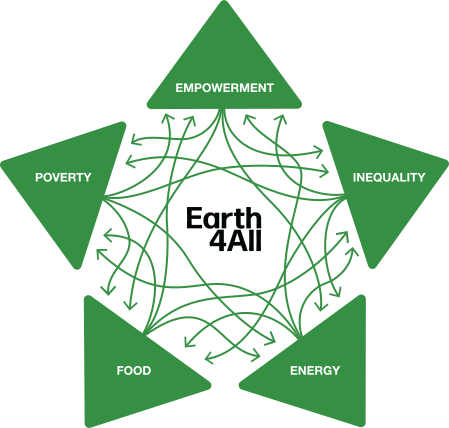
“Earth for All” looks at two scenarios that explore how population, economies, resource use, pollution, prosperity and social tensions could change in this century as a result of decisions made in this decade. The Earth for All Initiative was established to create a network of scientists, economists and thought leaders to explore pathways to the Sustainable Development Goals (SDGs). Supported by system dynamics models, the book explores pathways out of emergencies and brings humanitarian, social, environmental and economic benefits.

The book presents the results of the two-year Earth4All project, which looks at two scenarios for the period 1980-2100. The project was implemented by the Club of Rome, the Potsdam Institute for Climate Impact Research, the Stockholm Resilience Centre and the Norwegian Business School BI, with the participation of leading economists, scientists and sustainable development advocates. The main message of the book is clear: “If we do not control rising inequalities, societies will become dysfunctional. Yet the world has the opportunity to stabilise global temperatures below 2°C and end poverty by 2050.”

Scenario to the year 2100

Starting in 1980 and ending in 2100, the scenarios are called “Too Little, Too Late” and “The Giant Leap”, exploring how population, economies, resource use, pollution, prosperity and social tensions could change this century as a result of decisions taken in this decade.
Too Little, Too Late:

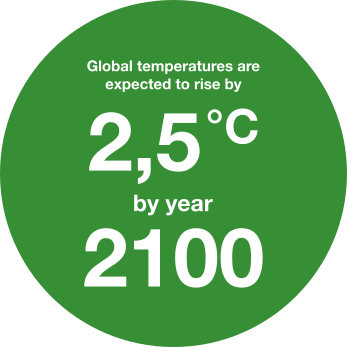
In the first scenario, global temperatures rise by about 2.5°C by 2100, a dangerously high level and well above the targets set in the Paris Agreement.

The projected consequences of this scenario are:
  • The poorest economies will face the most severe consequences as they will find it difficult to adapt to climate change. Many people will live in areas close to the limits of human survival.
  • All societies will be exposed to constant crises from extreme heat waves, droughts, crop failures and floods.

The model suggests that the likelihood of regional societal breakdowns caused by rising social tensions, food shortages and more severe environmental degradation will increase significantly in this scenario compared to today’s situation.
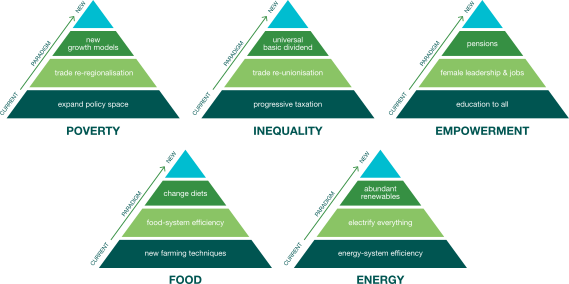
Pyramids that show the transition from the current state to a new state for poverty, inequality, empowerment, food and energy.
The Giant Leap:
The second scenario, the so-called Giant Leap, is achievable if companies immediately take and implement the actions that will lead to the five radical shifts:
1.
End poverty
by reforming the international financial system to lift 3-4 billion people out of poverty.
2.
Tackle gross inequality
by ensuring that the richest 10% receive less than 40% of national income.
3.
Empower women
to achieve full gender equality by 2050.
4.
Transform the food system to ensure healthy diets for people and the planet.
5.
Transition to clean energy to achieve zero emissions by 2050.

Comparison of the Earth4All initiative with scenarios and development planning for a sustainable low-carbon society in Slovenia

A similar methodology to Earth4All was used more than 10 years ago in Slovenia to find sustainable solutions to climate change.

The project scenarios Slovenia’s development up to 2035:
  • The first phase of designing a new development strategy for a low-carbon society.
  • The key part is the three development scenarios up to 2035.

60 experts were involved in designing the scenario of Slovenia’s development up to 2035.
What does the Green Oasis scenario bring?

  • Best results through early action, technological change and attitudinal change.
  • Introducing GDH (Gross Domestic Happiness) instead of GDP.
  • High energy efficiency and a shift to organic food production.
What do the other two scenarios entail?

  • No ideas (climate change denial).
  • Chameleon (too little, too late).

The project was the first comprehensive attempt to develop a sustainable development strategy through addressing the environmental problem of climate change. The results of both projects have been used in the formulation of Slovenia’s Strategy for the Transition to a Low Carbon Society 2050/2060.

Vision: an interconnected and inclusive low-carbon society with vibrant economy and high quality of life, living space and natural environment.

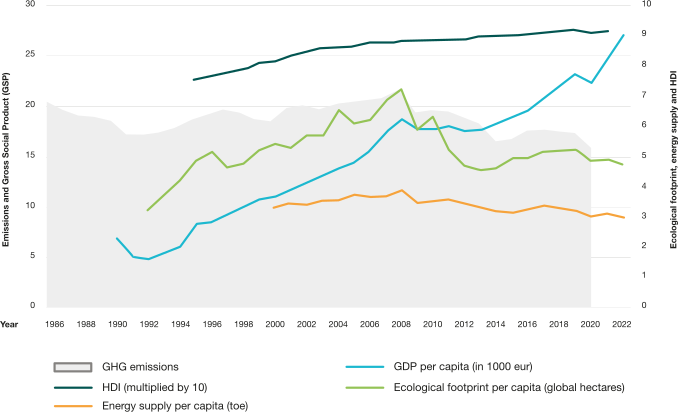
A diagram of key indicators of the reality of development in Slovenia.

The reality of development in Slovenia and prospects for a sustainable future

Given the scenarios described above, which were set more than a decade ago, and the latest scientific findings, the question arises as to where Slovenia stands today.

Either we are acting too little, too late, or we are in the process of a giant leap. Some key indicators that help us answer this question are shown in the diagram below.

Planetary boundaries

Discover various approaches to evaluating planetary boundaries and their consideration in the green transition.

The informational material includes detailed explanations of research approaches, analyses, and graphical representations.
The cover of the Planetary boundaries brochure.